
When preparing a proof of service there are a few options that we can use.
Its important to understand the distinction between a certificate of service, a statement of truth, a sworn affidavit and a notarised affidavit. Each serves a different purpose, and the correct procedure depends on the requirements of the court or receiving authority.
This guide explains their use in civil and family proceedings in England and Wales, together with the roles of a Commissioner for Oaths and a Notary Public.
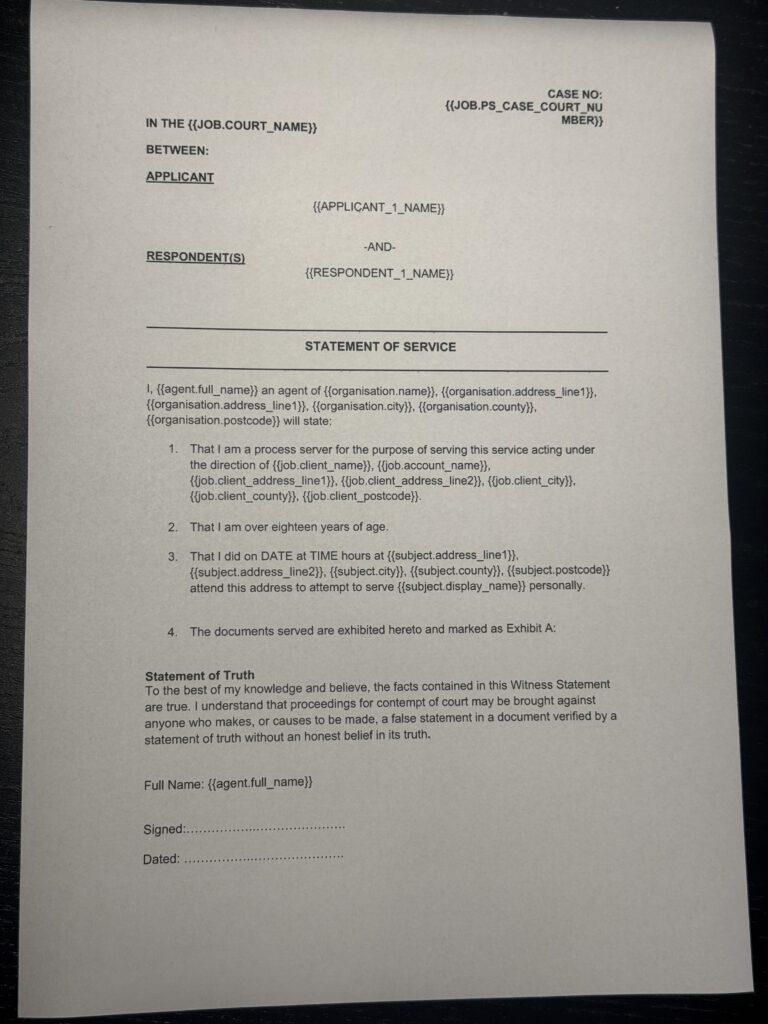
Certificate of Service and Statement of Service
A certificate of service provides formal confirmation that documents have been served on another party. In civil proceedings, Form N215 is commonly used for this purpose. It records relevant details of service and must be completed in accordance with the applicable procedural rules.
A statement of service is a broader description of a written account of how, when and on whom documents were served.
It is not necessarily a prescribed court form and should not be confused with a certificate of service where the latter is specifically required.
Under the Civil Procedure Rules, a certificate of service must be verified by a statement of truth where required by the applicable rules.
The Statement of Truth in Civil and Family Proceedings
The precise wording depends on the document being verified. The wording above applies to witness statements and should not automatically be used for every court document.
Statements of truth are used in a range of civil and family court documents, including witness statements and statements of case, where the relevant rules require them.
A statement of truth does not ordinarily need to be sworn before a Commissioner for Oaths or notarised. However, it cannot automatically replace an affidavit where sworn evidence is specifically required.
Sworn Affidavits
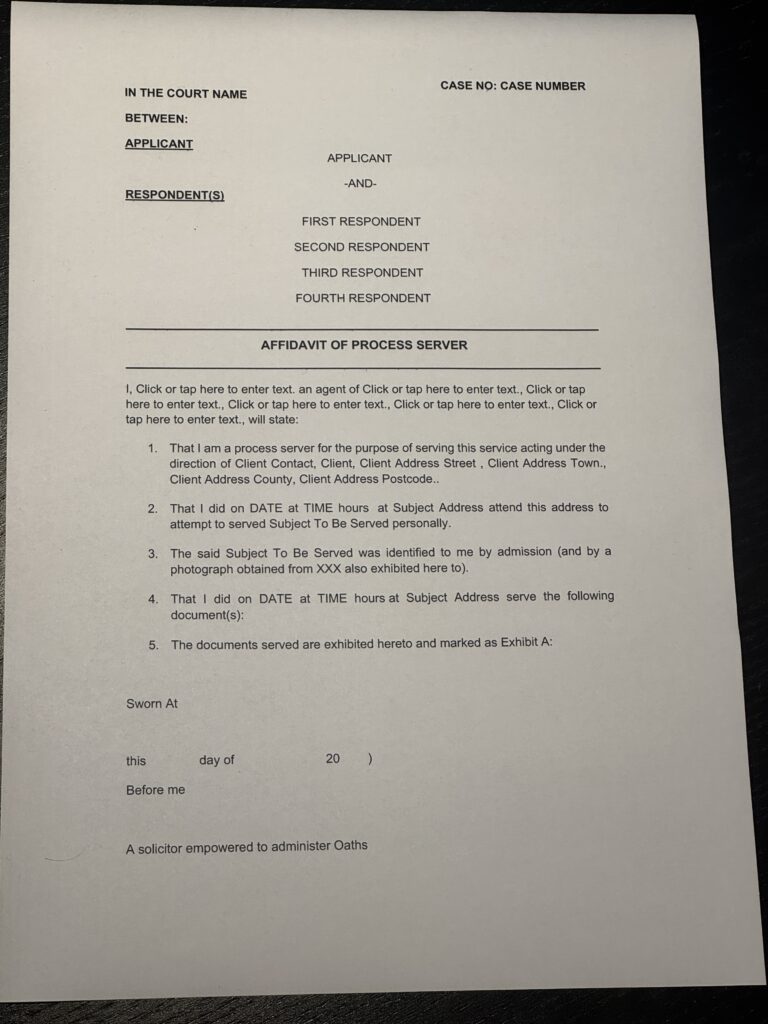
An affidavit is a written statement of facts sworn or affirmed before a person legally authorised to administer the oath or affirmation.
Unlike a statement of truth, an affidavit involves a formal oath or solemn affirmation.
The process server would swear usually in person in front of a commissioner for oaths such as a solicitor.
The affidavit includes a jurat recording when and where it was sworn or affirmed and before whom.
Affidavits are used where a court, statutory provision or receiving authority requires sworn evidence. They should be properly executed in accordance with the applicable legal requirements.
The Role of a Notary Public
A Notary Public is a specialist legal professional authorised to perform notarial acts.
In England and Wales, Notaries Public are appointed through the Faculty Office of the Archbishop of Canterbury and regulated by the Master of the Faculties.
Notarial work commonly involves authenticating signatures, certifying documents and preparing documents for use overseas. A Notary Public may also administer oaths and take affidavits.
Notarisation provides formal authentication of the relevant act or document; it does not automatically establish the truth of every factual statement contained within it.
Where a document is intended for use abroad, the receiving authority may also require an apostille or other form of legalisation.
Certificates of service, statements of truth, affidavits and notarised documents serve distinct legal functions. Understanding these differences helps ensure that documents are prepared and executed correctly.
A Commissioner for Oaths may be appropriate where an affidavit must be sworn or affirmed for domestic legal purposes. A Notary Public is generally required where a notarial act or authentication is specifically requested, particularly for documents intended for use abroad.
Before proceeding, the requirements of the relevant court or receiving authority should always be confirmed.
Why Choose KittyHawk Investigations
To Serve Your Court Documents
Experienced Professionals – Our team has years of experience in the legal field and knows the legal requirements for serving civil documents accurately. We are members of the Association of British Investigators (ABI)
Managed Service – Unlike some agencies and brokers who just take a cut and pass the work on. We manage each case and job ourselves providing you a key contact with our internal lead investigator.
Reliability – We pride ourselves on our reputation for reliable and prompt service, ensuring that your documents are delivered within the necessary timeframe.
Nationwide Reach – While we are based in London, our agents and process servers are available to cover the entire UK, ensuring you get the help you need, wherever you are.
Comprehensive Service – Whether you need one-off service or ongoing support, we offer customised solutions to suit your specific needs.
Legal Compliance – We ensure that every document is served in full compliance with UK law, giving you confidence that your legal proceedings won’t be delayed due to improper service.
If you need trusted, fast, and reliable process server, we are here to help. Whether you need to serve divorce petitions, child custody orders, or eviction notices, our team will ensure that your documents are delivered quickly, securely, and professionally.